Doctors are largely thin-skinned, arrogant, unintelligent, greedy sociopaths who care as little as possible about your medical condition and well-being.
:: journal :: 2026
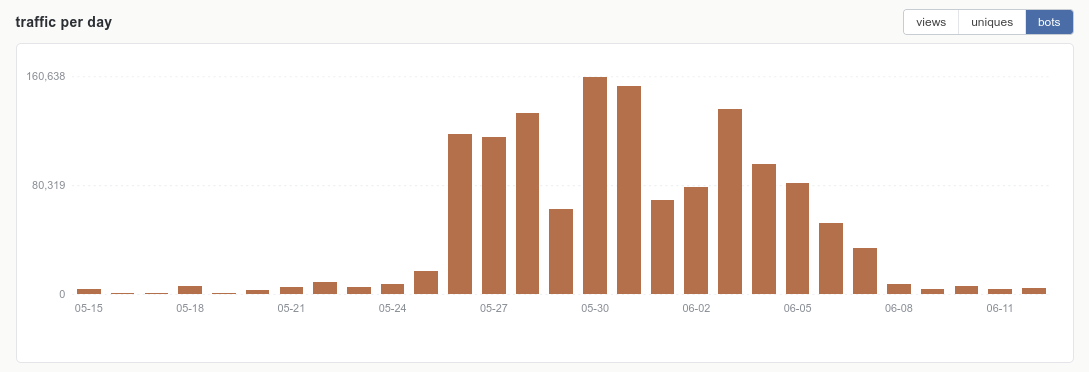
short-form posts, dated.An update on the LLM bot galore that brought my website down yesterday, trying to scrape the /git/ instance and testing my Perl CMS for WordPress vulnerabilities: I will shortly find a way to get to you.
It seems like three things are absolutely imperative for hosting anything public on the internet nowadays:
- Accurate traffic classification.
- Rate limits and priority/queued access tiers.
- Fast backends that don't serve too expensive things to people.
The depressing thing about tennis is that no matter how good I get, I'll never be as good as a wall.
-- Mitch Hedberg
Unstructured thoughts on "Quasipolyomial Cryptanalysis of the McEliece Cryptosystem (or: PIR Meets McEliece)", a 2026 preprint by Ghoshal, Ishai, Jain, Sun.
- I like the fact that McEliece has started attracting attention of researchers. I believe it to be the most secure, and most underrated public-key cryptosystem described in literature.
- The break is not as devastating as it looks like, but the result is rather impressive.
- The security of McEliece generally mainly hinges on the difficulty of random linear block codes are NP-hard and generally hard to decode, on average. McEliece's OW-CPA security furher follows from OW-CPA security of a uniform random matrix if the McEliece public key is indistinguishable from a uniform random matrix (of course, finding a distinguishing attack faster than the target OW-CPA security level would render this implication vacuous),
- The Classic McEliece security is tangential to distinguishing attacks, but it's important to point out that this is "not a two-way implication---perhaps there are distinguishers even if OW-CPA is secure". Even fast high-probability distinguishers would not be relevant to any of the Classic McEliece security claims.
- For an algorithm to have an effect on the Classic McEliece security analysis, it would have to be much faster than the distinguisher from the preprint and would have to be a key-recovery attack or something else that breaks OW-CPA.
- The authors truthfully acknowledge that the current gateway to a real attack beyond distinguishing is far fetched.
- Overall, it's pretty amazing that McEliece held out for 60 years without any substantially faster attack than the reduction to iSD.
- The idea is very beautiful and conceptually simple: First hold out one column, then compute the space of multilinear homogeneous polynomials of degree whose Hasse derivatives of order below vanish at every remaining column, then check whether those polynomials also vanish at the held-out column. for a Goppa key the answer is forced by Hermite interpolation. for a random matrix it fails with constant probability.
A (hopefully not horribly unsafe) CSPRNG based on Feistel networks with a nonlinear kernel in GF(256), as seen in the 4th iteration kcrypt.
  #include <errno.h>
  #include <fcntl.h>
  #include <signal.h>
  #include <stdint.h>
  #include <stdio.h>
  #include <unistd.h>
  #define Fi(n,a...) for (int i = 0; i < n; i++) { a; }
  #define Fq(n,a...) for (int q = 0; q < n; q++) { a; }
  #define _(a...) { return ({ a; }); }
  #define S static
  typedef uint8_t gf;
  typedef struct { gf k1[32], k2[64]; } bk;
  typedef struct { gf k2[64], rk[16][32], p[16][32]; } bc;
  S void wipe(void * p, size_t n) { Fi(n, ((volatile gf *) p)[i] = 0) }
  S gf mul2(gf x)_(  x << 1 ^ (gf) -(x >> 7) & 0x1d)
  S gf eq(gf a, gf b)_((uint32_t) (a ^ b) - 1 >> 8)
  S gf mul(gf a, gf b)_(gf r = 0;  Fi(8,
      r ^= a & (gf) -(b & 1), b >>= 1, a = mul2(a))  r)
  S gf inv(gf x)_(gf x2 = mul(x, x), x3 = mul(x2, x), x6 = mul(x3, x3),
    x12 = mul(x6, x6), y = mul(x12, x3);  Fi(4, y = mul(y, y))
    mul(mul(y, x12), x2))
  S gf mod8(gf x, gf m)_(uint32_t r = 0, t;  Fi(8,
      t = (r += r + (x >> 7 - i & 1)) - m;  r = t + (m & -(t >> 31)))  r)
  S void shuffle(gf p[32], gf key[64], int round) {
    Fi(32, p[i] = i)  Fi(31, int n = 31 - i;
      gf j = mod8(key[n + round * 21 & 63], n + 1), t;
      Fq(32, t = (p[n] ^ p[q]) & eq(q, j);
        p[n] ^= t;  p[q] ^= t))}
  S void permute(gf out[32], gf in[32], gf p[32]) {
    Fq(32, gf x = 0;  Fi(32, x |= in[i] & eq(i, p[q]))  out[q] = x)}
  S void diffuse(gf a[32]) { gf b[32], * x = a, * y = b, * t;  Fq(4,
      Fi(32, y[i] = x[i] ^ mul2(x[i + q * q + q + 1 & 31]))
      t = x;  x = y;  y = t)  wipe(b, sizeof b); }
  S void setup(bc * c, bk * key) {
    gf z[2][32], * s = z[0], * u = z[1];
    Fi(64, c->k2[i] = key->k2[i])  Fi(32, s[i] = key->k1[i])
    Fq(16, shuffle(c->p[q], c->k2, q);  permute(u, s, c->p[q]);
      Fi(32,
        c->rk[q][i] =
          inv(u[i] ^ mul2(u[i + 1 & 31])
            ^ c->k2[i + q * 17 & 63] ^ ((q + 1) * 0x9d + i))
          + c->k2[i + 32 + q * 29 & 63])
      diffuse(c->rk[q]);  Fi(32, s[i] = c->rk[q][i]))
    wipe(z, sizeof z); }
  S void block(gf out[64], gf in[64], bc * c) {
    gf z[4][32], * l = z[0], * r = z[1], * n = z[2], * u = z[3], * t;
    Fi(32, l[i] = in[i];  r[i] = in[32 + i])
    Fq(16, permute(u, r, c->p[q]);
      Fi(32,
        n[i] =
          c->rk[q][i]
            + inv(u[i] ^ mul2(u[i + 1 & 31]) ^ c->k2[i + 32 + q * 11 & 63]))
      diffuse(n);  Fi(32, n[i] ^= l[i])  t = l;  l = r;  r = n;  n = t)
    Fi(32, out[i] = l[i];  out[32 + i] = r[i])
    wipe(z, sizeof z); }
  S int randomize(void * v, size_t left)_(
    gf * p = v;  int fd = open("/dev/urandom", O_RDONLY);
    if (fd < 0) return -1;
    while (left) {
      ssize_t n = read(fd, p, left);
      if (n > 0) p += n, left -= n;
      else if (n < 0 && errno == EINTR) continue;
      else {
        int e = n < 0 ? errno : EIO;
        close(fd);  errno = e;  return -1; }
    } close(fd))
  S int putall(void * v, size_t left)_(
    gf * p = v;
    while (left) {
      ssize_t n = write(STDOUT_FILENO, p, left);
      if (n > 0) p += n, left -= n;
      else if (n < 0 && errno == EINTR) continue;
      else if (n < 0 && errno == EPIPE) return 1;
      else { if (!n) errno = EIO;  return -1; } }  0)
  int main(void)_(
    struct { bk key; gf nonce[16]; } seed = {0};
    bc c = {0};  gf in[64] = {0}, out[64] = {0};  int rc = 1, w;
    if (signal(SIGPIPE, SIG_IGN) == SIG_ERR)
      { perror("signal");  goto done; }
    if (randomize(&seed, sizeof seed) < 0)
      { perror("/dev/urandom");  goto done; }
    setup(&c, &seed.key);
    Fi(16, in[i] = seed.nonce[i])  in[63] = 3;
    wipe(&seed, sizeof seed);
    for (uint64_t counter = 0;; counter++) {
      Fi(8, in[16 + i] = counter >> i * 8)
      block(out, in, &c);
      if ((w = putall(out, 64)) > 0)
        { rc = 0;  goto done; }
      if (w < 0)
        { perror("stdout");  goto done; }
      if (counter == UINT64_MAX)
        { fputs("krng: counter exhausted\n", stderr);  goto done; } }
  done:
    wipe(&seed, sizeof seed);  wipe(&c, sizeof c);
    wipe(in, sizeof in);  wipe(out, sizeof out);
    rc)
Seeing my dad in Poland again next month.
He who fights with monsters should look to it that he himself does not become a monster. And if you gaze long into an abyss, the abyss also gazes into you.
Always one step forward, two steps backward...
I am now one year older, at the ripe wise age of 22.
Life is so miserable when the world is turned all against you. Thinking back, I am sure that I did everything right.
But this is nothing to solace the overreaching feeling that I should've done something to stop my life from ever reaching this point; of what feels like both stagnation and Sisyphean clawing of the most trivial from life.
The most widespread individuality of writers consists, after all, in the fact that each conceals his bad qualities in an entirely particular way
-- F. Kafka
The concept of “mental health” in our society is defined largely by the extent to which an individual behaves in accord with the needs of the system and does so without showing signs of stress.
-- Theodore Kaczynski
My thoughts on Dave's (@ratfactor) post "A programmer's loss of a social identity" (I recommend reading the original before the response below!)
Hi Dave,
Thanks for your article. It articulates a lot of the thoughts that I had on this subject matter too, but I never really crossed the threshold of displeasure to publish about them.
Which is to say that the pleasure I get from programming is mostly about learning the underlying truths about computation and applying what I’ve learned. Always improving the craft. This, to me, is the practice of programming.
When I was younger I also liked entertaining the idea that learning things is fun. I've built a bit of a name for myself for doing esoteric languages (know Malbolge? Wonder who proved it Turing-Complete after 20 years?) and other useless stuff purely because the path from A to Z was quite fun.
The transformation has been bewildering. It feels like the blink of an eye, though I guess it’s been about three years. The culture has changed immensely in that short time. When I identified with the programmer culture, it was about programming. Now programming is a means to an end ("let’s see how fast we can build a surveillance state!") or simply an unwanted chore to be avoided.
You're not going to like this, but I feel like this joy is now behind me 🙁. I have adulted, found a job, and realised that nobody will really appreciate all of these nifty things, while I still have to - unfortunately - cater to my physiological needs to eat and sleep. Programming no longer feels like something enjoyable by itself, because I need a result for my upcoming paper, or I have so many things unrelated to the bread and butter of computing to do that I simply can't nurture my curiosity by programming anymore.
I was very lucky, riding a wave of personal computing on an upward slope that probably started sometime during the radical advent of home computers in the 1980s and continued well into the 2010s.
I vehemently disagree.
The world was always this cruel: when I was young, I chose to ignore nay-sayers and decided that learning stuff, regardless of how immediately useful it seems, is a good idea and judging by the track on which my life is now - the effort paid off. But for each person who appreciated it, there were ten who would go out of their way to say that I'm wasting time for not building soulless products. It's no wonder that people these days turn to LLMs.
I think that the reason why you observe the things you do is the unfortunate, noxious grip of capitalism that haggles for the remaining bits of immediate value of Human Resources. If I didn't fear for my immediate future, I would do what I would really love. But these days, all I can do is to slowly kindle away. Thankfully nobody is pointing a gun at me and making me use LLMs, so maybe it's not as bad as it could have been.
If the problem is that we’ve painted our development environments into a corner that requires tons of boilerplate, then that is the problem. We should have been chopping the cruft away and replacing it with deterministic abstractions like we’ve always done.
Regarding this intermezzo on abstraction: It's agreeable if you look at it from a perspective of a programmer. The general trend of trying to get rid of these pesky and annoying programmers has started way back. BASIC, COBOL, SQL, all meant to make programming more accessible to non-programmers. The early 1990s brought CASE (Computer-Aided Software Engineering). Under the premise that code produced by human programmers is substandard, but that they are nonetheless excellent at modelling and creating specifications, we attempted specification-driven code generation for the first time. Around the same period, UML was invented. How is it that you have (most likely) never heard of CASE? The principal problem with it, deep down, is that it never worked. When generating code, the best the tools could do was create all the classes for you and perhaps define the methods for the class. The tools could not provide an implementation unless they also managed the implementation within the tool itself, which was dreadful. The early 2020s brought LLMs, no comment needed here.
OOP is not a tool of thought, it is rather a tool of source code obfuscation. It's never implemented properly, trades implementation details for structural features, and exists solely to serve as a balm to the soul of the middle-level manager in his pursuit of the Plug&Play Programmer.
I’ll say the really awful part now: For the first time in my life, I’m suddenly wary of meeting other "computer programmers" in the wild.
I hate programmers too.
--
With Valediction, Kamila Szewczyk (https://iczelia.net)
We must either learn to live together as brothers or we are all going to perish together as fools.
-- Martin Luther King Jr.
More people die of heat stroke in Europe (161 daily; [1]) than in school shootings in America (12 daily; [2]). Maybe it's time to stop laughing at them and install AC units in residential buildings.
Whoever does not regret the destruction of the Soviet Union doesn't have a heart, whoever wants to recreate it doesn't have a head.
-- A. Lebed
They portrayed us as morons – as though nothing better might have been expected. It is true that Dr. O. Kazachkovsky, contrariwise, termed us “professionals” – a balm to the soul, though not without its admixture of tar. Many took occasion to speak at our expense. According to them, the staff committed violations so extraordinary as to border upon the fantastic. But that is the privilege of the scientist: he is inventive. And the press dutifully transmitted these inventions to the public.
-- A. S. Dyatlov
Theorem: ThinkPads with double the charging ports (2x USB-C) have double the average lifespan.
One thought that i should have capitalised on in the "Linear-time KL-optimal frequency normalisation" paper:
The core of Huffman's algorithm is a KL-optimal frequency normaliser from any distribution to the dyadic distribution. once any PMF is turned dyadic ( ), lengths are obvious and thus codes are also obvious via canonical coding.
My paper is a KL-optimal frequency normaliser from (after minor adjustments) any distribution to any distribution. So in principle we can turn the result from my paper into an optimal prefix code as follows:
- ask the O(n) algorithm for quantisation to

 are integer; computable via
 __builtin_clz. standard canonical code algorithm provides an onto-mapping from lengths to codes.
so the paper is in fact the unifying theory of huffman (), ANS ( ) and arithmetic coding (
 ).
).
28/06/2022 -- 15/06/2026.
3 years, 11 months, 19 days.
16:53: The website is running once more after a hosting provider switch. Currently e-mail and Matrix are still defunct. I expect this to change soon. Many issues have surfaced during the re-deploy on a newly provisioned server.
21:32: Everything is operational again.
I would like to dedicate today's journal note to Meta Platforms, Inc., that seems to have learned just last week how to implement rate limits in their shitty AI scrapers.
When one sleeps on the floor one need not worry about falling out of bed.
-- A. S. LaVey
I bought a dot matrix printer.
Peer review basically means: Government by the scientists, of the scientists, for the scientists. [...]
My ThinkPad keyboard is broken again and I have to pay a ridiculous amount of money for a spare part.
I do not know which makes a man more conservative -- to know nothing but the present, or nothing but the past.
-- J. M. Keynes
The avoidance of taxes is the only intellectual pursuit that still carries any reward.
-- A. MacKay
Happy Pride!
For my part I think that capitalism, wisely managed, can probably be made more efficient for attaining economic ends than any alternative system yet in sight, but that in itself it is in many ways extremely objectionable.
If farming were to be organised like the stock market, a farmer would sell his farm in the morning when it was raining, only to buy it back in the afternoon when the sun came out.
It is impossible to escape the impression that people commonly use false standards of measurement — that they seek power, success and wealth for themselves and admire them in others, and that they underestimate what is of true value in life.
-- "Civilization and Its Discontents", Sigmund Freud
Thus we may have knowledge of the past but cannot control it; we may control the future but have no knowledge of it.
-- Claude E. Shannon
Wer sich aber zum Wurm macht, kann nachher nicht klagen, dass er mit Füßen getreten wird.
-- Die Metaphysik der Sitten (1797)
"I proclaim that justice is nothing else than the interest of the stronger. [...] And the different forms of government make laws democratical, aristocratical, tyrannical, with a view to their several interests; and these laws, which are made by them for their own interests, are the justice which they deliver to their subjects, and him who transgresses them they punish as a breaker of the law, and unjust. And that is what I mean when I say that in all states there is the same principle of justice, which is the interest of the government; and as the government must be supposed to have power, the only reasonable conclusion is, that everywhere there is one principle of justice, which is the interest of the stronger."
-- Plato, The Republic
I want to see my dad again, but I will not have a chance for a two week holiday anytime soon. We will start playing online chess together.
Failure possesses a strange beauty: despite its ontological negativity, it compels us toward growth and knowledge. I fail many times, but each failure leaves me altered; I do not return to the same mistake as the same person.
Daniel Bernstein:
I thank God for not making me a computer scientist.
The reasonable man adapts himself to the world; the unreasonable one persists in trying to adapt the world to himself. Therefore all progress depends on the unreasonable.
Larry Wall on Lisp:
Lisp has all the visual appeal of oatmeal with fingernail clippings mixed in.
The time allotted to us is far smaller than it seems. So do not depart too cleanly. Remain a while at the threshold, awkward and undecided. Leave some small part of yourself behind in my life, so that you may have a reason to return.
The deeper lesson of survivorship bias is that success is not merely to be studied from those who endured, but pursued by shaping oneself toward endurance.
Descartes to Mersenne, xii.1638:
[Descartes expresses several dissatisfactions with Fermat, summing up thus:] I have seen many of his writings, in which I have found two or three good things mixed in with many bad ones. Between ourselves, I think of them in the way Virgil thought of Ennius, when he extracted ·little bits of· gold from his works under the title The dung of Ennius [in the background of that slur is a Latin idiom, aurum e stercore = ‘gold from dung’]. But this is between ourselves, because I still want to be his ‘Yours faithfully’ if he wants that.
Criticising APL for its glyphs by newbies makes perfect sense.
I want to win the Pulitzer prize; but how, oh how, do I learn all of these letters of the alphabet?
A trick question is designed to trick, not test your knowledge.
Wherever life has placed you, do not mistake it for a waiting room. Do not pass through your college years as though they are merely a corridor to employment, nor through your solitude as though it is only the absence of love. The things that are meant to arrive will arrive in their season, and they may be good when they do.
But there is a particular sorrow in looking back and realizing that you abandoned whole years of your life because you were busy longing for a different one. To grow, to strive, to become more than you are... these are noble things. But do not neglect the present in the name of the future. The present is not an interruption of your life. It is the only place from which your life can be made.
It seems like every consumer trend is just briefly renting a piece of plastic on its journey from a suicide-net Xinjiang gigafactory to the local dump.
This morning's story: Tried to print 6 pages. The printer was very slow at ~1pg/min. 5 pages in, it printed a compatibility error. I downgraded the PDF version. Then it printed fine, but without minus signs. Then I tried to print bare PostScript, but the printer turned out to not support that.
Now that AI companies are enjoying their RAM/GPU/etc grab, it's important to point out that owning hardware gives you sovereignty: the best time to buy hardware was yesterday, the next best time is today.
I feel an unstoppable urge to make my website a bit more lively and 00's styled.
Placed #4 in the 4k Executable Graphics competition at Revision 2026.
fgetxattr(54321, NULL, NULL, 0); apparently crashes yesterday's 6.6.y lts kernel.
The only program that stands a chance of being correct is a remarkably short one.
Apparently FitGirl Repacks uses bzip3, so does CERN for their ROOT I/O (?).